
Go Goa Gone
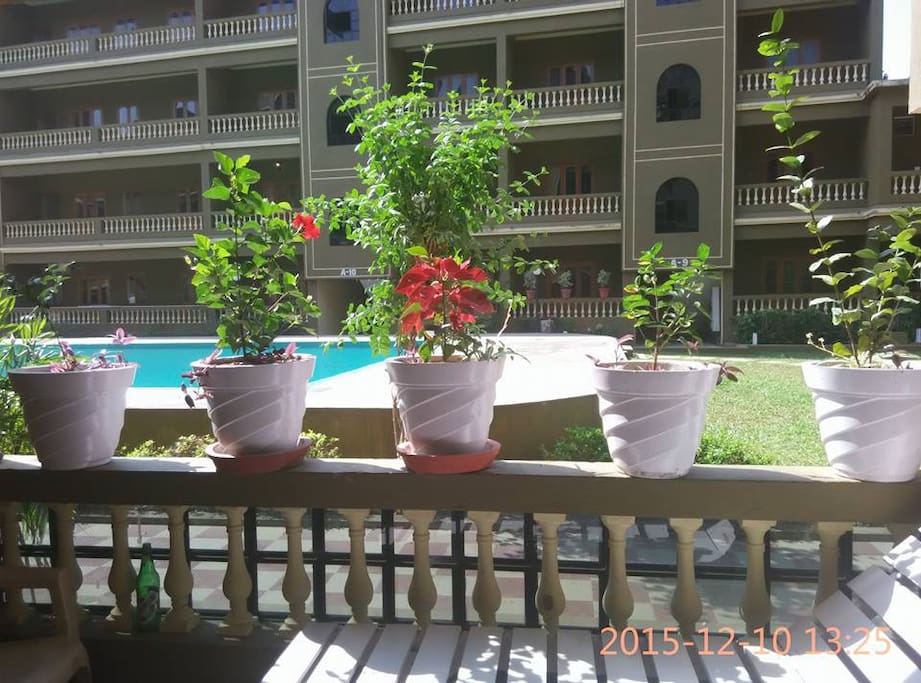
Poolside 1 BHK Apartment in Resort
Siolim, Goa, India
Serene Siolim- Gateway to the pristine beaches of North Goa at Tropical Dreams Resort with Lush green surroundings Ground Floor across the biggest swimming pool in Goa is furnished with SplitAC Ref...Vacation Rentals in Siolim
Friday, June 11, 2010


Thursday, June 10, 2010
Hinduism and Democracy: A Comparison by Ashok M. Kuber, PhD
Hinduism and Democracy: A Comparison by Ashok M. Kuber, PhD Source: www.prlog.org
May 10, 2010 – The basic principles of democracy were embedded in Indian Civilizations and its religions long before they occurred in the West. Democracy in Europe was born in people’s struggle against Church and ruthless rulers. Democracy is not limited to elections and majority rule. More importantly, democracy involves freedom of expression and liberty – along with equal opportunities and protection of all minorities. Throughout history, religions of Indian origin have imbedded these principles in their belief.
Hindu scriptures, Vedas, are a collection of teachings from over many thousand years. Hinduism allows followers to interpret scriptures according to the current times.
Dogmatic interpretation and its forceful execution are not a part of Hinduism, as it has been with Islam and Christianity. These religions often ignore the basic teachings of their founders.
Hinduism does not seek converts. No forceful or violent conversion, no religious wars with Christians, Jews, Jains, Sikhs, Buddhists, atheists occurred until Islam came to India . You can become Hindu by your own free will by accepting Bhagavad-Gita, essence of Vedas spoken by Lord Krishna as a final authority. The mythology of Purana or the great epics Ramayana or Mahabharata explain the Vedas to common people in a simple way. Numerous sects of Hinduism co-exist peacefully under the supreme guidance from the Vedas.
Hinduism offers lots of freedom to operate. An individual decides his Guru, and follows him or her. When many devotees come together a sect is formed. Like democracy, the people select a leader. Sects come and go like political parties in a dynamic democracy.
Often, those of other faiths portray Hinduism as a religion of confusion. It is like communist or a dictator might consider democracy as a confused state where the news media, congressmen, senators, the president and scholars challenges each other dramatically and sometimes unreasonably. Like American democracy, where challenging a President or burning a flag is tolerated - Hinduism tolerates challenges. Contrast to Hinduism, Christianity and Islam offer very limited freedom and tolerance for other faiths.
According to Hinduism, there are different paths to reach God, just like there are many ways to reach the top of the mountain. As you go higher, differences between them are reduced. Anyone who believes that his is the only way to reach God is full of ignorance just like a frog in a well unable to comprehend the outside world. Bhagavad-Gita suggests the following Yogas to reach God: Knowledge, Devotion, Meditation, and Karma. Karma Yoga is pure selfless service. Missionary service is not Karma Yoga, as missionaries hope to convert people to their faith and thus expand their power base to reestablish domination of the church which will ultimately curtail democracy.
Vedas means knowledge. It is not only religious rituals with chanting of hymns, but it includes philosophy, astronomy, mathematics, medicine, and grammar. When philosophy is the origin of religion, it permits freedom of speech and thought, and acknowledges Atheism. Just like democracy, Hinduism accepts Atheists as equal citizens.
About 2300 years ago India peacefully became predominantly Buddhist during the Maurya Empire. During that period, Takshila University was the center of learning Hinduism, Jainism and Buddhism and Atheism. Also, Nalanda University was formed 2000 years ago with its 10,000 students and 1500 teachers. In the 8th century Hindu Guru Shankracharya debated one to one Hindu, Jain, Buddhist and Atheist women and men gurus who upon defeat accepted his synthesis of Vedic metaphysics philosophy and India became again predominantly Hindu.
According to Hindu philosophy there is one GOD, an eternal, formless, supreme, all pervading spirit. Observed multiplicity in the Universe is just like the waves in the ocean - they come and go. Waves are nothing but sea water which is the only essence, just as the supreme spirit is the only essence (the underlying reality). As a Hindu, one is free to worship a formless GOD in any form and name one wish. As you progress spiritually, you will realize the absolute invisible all pervading supreme spirit. No one is between you and GOD. Religion and the holy man just give you the direction, but they are not the end. This assures individual freedom and discourages dictatorial control with its abuses.
Ridicule of the caste system in Hinduism by others is extremely overdone. Critics must look at their own history of religious wars, bloody conversion and annihilation of natives in occupied lands. The caste system was a class system not by birth but by profession: Labor, Merchants, Ruler (warriors) and Brahmin (teachers and preachers). The King and his ministers collectively ruled the kingdom according to very strict ethic rules given in the Vedas which protect freedom and liberty. Brahmins were mainly teachers until the later part of the Buddhist period (6 A.D.), when they started temples and idol worshipping and were mainly involved in the religious rituals. At about that time, they became Brahmins by birth in order to protect their livelihood. Movement between other classes was more or less free.
Chanakya of Takshila University, who contributed economics in the Vedas, uprooted the Greek Alexander's rule from India and established the Maurya Empire by appointing his student, who was born in the labor class, as a king. The great sages, who wrote the most important Hindu scriptures Puranas, Mahabharata and Ramayana, were born in the labor class!
The caste system already coexisted and there were no real conflict between the groups. Untouchability is often misunderstood and Hinduism has nothing to do with it. Untouchables were outclass persons who had committed crimes. In other civilizations, criminals and their family were killed. In India , they were put out of society and given cleaning jobs. Unfortunately, their families remained untouchables for subsequent generations. The efforts of Hindu reformers and the civil rights laws have brought the untouchables back into society - resulting in the election of an untouchable as President of India in 1997.
In AD 52, the apostle St. Thomas came to South India . His followers known as Syrian Christians were free to practice their apostolic faith. However, during the Portuguese colonial rule, the Catholic Church forcefully absorbed them. Next the British rule came and the Protestant Church ruled them. After India became independent, the followers reestablished the Syrian Christian Church of India free from European control. When Jews and Zoroastrians (Parsis) came to India to escape persecution, they were given shelter and were free to practice their faith. Contributions of these relatively miniscule minorities to India have been immense, and their success in every aspect of life is striking. In India non Hindus including Christians and Muslims have occupied many top positions including president and prime minister without a single threat of violence against them from the 80% majority Hindus.
Recently, America broke the racial barrier by electing the first black president. Even though there is freedom to practice any religion in western nations, most of them have Christianity as a state religion. US constitution states only separation between state and church. In reality, USA is not a secular nation. America and the West have a long way to go to break the religious barriers in order to catch up with India . For Islamic democratic countries, even separation of state and religion is a mere dream. A real democracy requires secularism in practice and India is the only major nation who can claim this. The credit goes to Hinduism.
The author is thankful to Dr. Dilip Amin and Mr. Sam Barnabas for valuable suggestions.
Ashok M. Kuber, PhD
Lansdale, PA
Contributed to www.InterfaithShaadi.org
Friday, June 4, 2010
The God Project: Hinduism as Open-Source Faith by Josh Schrei
The God Project: Hinduism as Open-Source Faith by Josh Schrei
Josh Schrei is a full time Marketing Director and a part time writer, activist, critical thinker, and student of Indo-Tibetan history and philosophy. His work focuses on the dissection of all-too-common memes in China-Tibet propaganda and American political and religious thought.
UNITED STATES, June 2, 2010: Trying to explain the core beliefs of “Hinduism” to an interested observer can be challenging to say the least. Its often stated that the word “Hinduism” itself is a total misnomer, as it basically refers to the sum total of spiritual and religious thought and practice that has taken place on the Indian subcontinent over the past 5,000 years. And lets just say it’s been a busy 5,000 years. The sheer volume of spiritual literature and doctrine, the number of distinct Gods worshiped (over 30 million, according to some sources), the breadth of distinct philosophies and practices that have emerged, and the total transformation over time of many of the core Indic teachings and beliefs can be disconcerting to those raised in monotheistic cultures, as we are used to each faith bringing with it a defined set of beliefs that — with the exception of some denominational rifts over the centuries — stay pretty much consistent over time.
However, the key point of differentiation between Hinduism and these other faiths is not polytheism vs. monotheism. The key differentiation is that “Hinduism” is Open Source and most other faiths are Closed Source. “Open source is an approach to the design, development, and distribution of software, offering practical accessibility to softwares source code.”
As the Gods change and the evolution of Indic thought leads us to increasingly modern and post-modern views of the nature of reality, the old Vedic codes still remain front and center. One of Hinduism’s defining factors is that the historic view of god, the nature worship and shamanism, never went away, so that god as currently worshiped exists simultaneously as symbol and archetype as well as literal embodiment.
That Shiva, for instance, could simultaneously be the light of ultimate consciousness and an ash-smeared apparent madman who frequents cremation grounds is a delight to us spiritual anarchists, while mind numbing to most western Theologists. Western and Middle Eastern monotheistic faiths have simply not allowed such liberal interpretation of their God. They continue to exist as closed source systems.
“Generally, closed source means only the binaries of a computer program are distributed and the license provides no access to the program’s source code. The source code of such programs might be regarded as a trade secret of the company.” One of the defining facts of Christian history is that access to God has been viewed — as in most closed source systems — as a trade secret. The ability to reinterpret the bible, or the teachings of Christ, or the Old Testament or to challenge the basic fundamental authority of the church has been nonexistent for most of the church’s history. Those who dared to do so were quite often killed.
In Indic thought, there is no trade secret. The foundation of yoga is that the key to god, or the macrocosm, or the absolute … lies within the individual and can be accessed through a certain set of practices. It’s a beautifully simple but ultimately profound concept that has been allowed to flourish unchecked for millennia. The process of discovering and re-imagining the divine is in your hands. The God Project.
Wednesday, June 2, 2010
Time to Analyse for Neighbour and Indian success stories
First thing you need to do at this stage is . . read your Book. . with a clear mind and conscience . .
Second thing, look back at your country . . why it was founded, what happened when it was founded how it has progressed in the past 62yrs and what you have contributed to your country . .
Try to think with a neutral, non judgmental conscience with literature from your own country as well as from writers from the western world and Indian authors..
Once you have read the arguments from all the sides, only then would you be in a position to make up your mind based on facts . .
Otherwise you are just going to be a one in the mob or a sheep in a herd . .
NB: for your info. Satyam is not dead . . it still supports the IT system of more than half of the fortune 500 companies around the world. At the moment it is being restructured. . Further atleast we have got some companies to even involve in malpractice . .
Indian Tata’s own Land Rover and Jaguar… Mittal steel is one of the biggest in the world . . I can give you an unending list of Indian success stories . .
victims of terrorism
As with most libs, you say what we shouldn't do, never what we should do. Other than tuck our tails between our legs and whimper away, what do you propose we do to show the world we will not just sit back and be victims of terrorism?
"Appeasement only insures that the crocodile will eat you last!"
"Appeasement only insures that the crocodile will eat you last!"
You cannot be friends with people who think you don't deserve to live if you aren't like them.
You cannot be friends with people who think you don't deserve to live if you aren't like them.
Subscribe to:
Posts (Atom)